AI in Social Media Management: 10 Smart Ways to Work Faster and Grow Your Brand
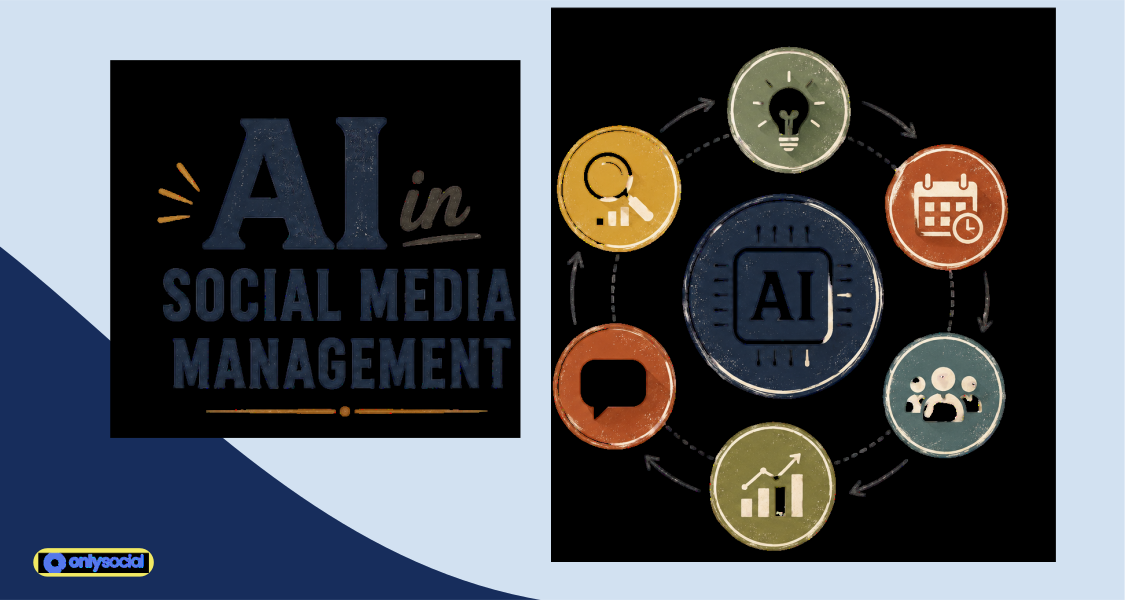
Social media rarely slows down. New trends appear overnight, audience preferences shift constantly, and brands are expected to create more content than ever while staying relevant across multiple platforms.
Trying to keep up manually can quickly become overwhelming, especially for small teams and growing businesses.
That’s where AI is changing the game. Instead of replacing marketers, AI helps them work smarter. Used well, it gives social media managers more time to focus on creativity, strategy, and building genuine connections with their audience.
In this guide, you’ll learn how AI is transforming social media management, the practical ways brands are using it today, and how you can make it part of your own marketing workflow.
Table of Contents
- 1 What Is AI in Social Media Management?
- 2 Why AI Has Become Essential for Social Media Success
- 3 10 Ways AI Is Transforming Social Media Today
- 3.1 1. Speed Up Content Creation Without Sacrificing Quality
- 3.2 2. Social Listening and Trend Analysis
- 3.3 3. Automate Scheduling and Simplify Your Workflow
- 3.4 4. Audience Targeting and Personalization
- 3.5 5. Performance tracking and optimization
- 3.6 6. Advanced Customer Service Automation
- 3.7 7. Keep a Close Eye on Your Competition
- 3.8 8. Create Better Visual Content in Less Time
- 3.9 9. Risk Detection and Crisis Monitoring
- 3.10 10. Find the Right Influencers Faster
- 4 Common Mistakes to Avoid When Using AI for Social Media
- 5 Examples of Brands Using AI for Social Media the Right Way
- 5.1 Mastercard: Using AI data analysis to Spot Trends Before Everyone Else
- 5.2 Louis Vuitton: Protecting Its Brand Through AI-Powered Sentiment Analysis
- 5.3 Chipotle: Turning Customer Sentiment into Better Campaigns
- 5.4 Mercedes-Benz: Pulled Data Using AI to Create a Responsive Campaign
- 5.5 The NFL: Personalizing Content for Global Audiences
- 6 Smarter Social Media Starts With Smarter AI
- 7 Frequently Asked Questions
What Is AI in Social Media Management?
AI in social media management refers to the use of artificial intelligence to help brands plan, create, schedule, publish, monitor, analyze, and improve their social media activities.
Rather than relying entirely on manual work, businesses can use AI to streamline repetitive tasks, uncover valuable insights, and make faster, more informed decisions across their social channels.
The real value of AI isn’t that it replaces marketers. It enhances what they already do.
AI can help identify emerging trends, generate content ideas, recommend the best times to post, analyze campaign performance, and even assist with customer interactions. Meanwhile, your team remains in control of the strategy, creativity, and brand voice that make your business unique.

Why AI Has Become Essential for Social Media Success
AI is no longer a nice feature to have. For many brands, it’s becoming one of the biggest competitive advantages in social media management.
As audiences grow and conversations happen around the clock, keeping up manually becomes increasingly difficult. Customers also expect faster responses than ever before. According to recent reports, 73% of consumers expect brands to respond on social media within 24 hours. Falling behind doesn’t just affect engagement. It can also affect trust, customer satisfaction, and sales.
Here’s why more businesses are making AI part of their social media strategy.
It Helps You Spot Trends Earlier
Social media trends can appear and disappear within days – or even hours.
AI can continuously monitor conversations across platforms and identify emerging topics before they become mainstream. This gives your team more time to create relevant content, join important discussions, and stay ahead of competitors instead of constantly reacting after a trend has already peaked.
It Makes Sense of Large Amounts of Data
Every comment, mention, review, and direct message contains valuable information.
The problem is that most businesses simply don’t have the time to analyze everything manually.
AI helps organize that information by identifying patterns, measuring audience sentiment, and highlighting the conversations that deserve immediate attention. Instead of drowning in data, your team gets insights they can actually use.
It Improves Customer Response Times
Social media has become one of the first places customers go when they need help.
AI-powered tools can prioritize urgent messages, suggest responses, and automate routine interactions, allowing your team to respond more quickly while still providing a positive customer experience.
Your customers receive faster support, and your team spends more time handling conversations that genuinely require a human touch.
It Supports Smarter Marketing Decisions
AI doesn’t just collect data. It helps you understand what the data means.
From identifying your highest-performing content to revealing which audience segments engage the most, AI gives marketers clearer insights into what’s working and what needs improvement.
That means future campaigns are based less on guesswork and more on evidence.
It Gives Your Team More Time for Creative Work
One of AI’s biggest strengths is handling repetitive tasks.
Whether it’s organizing reports, suggesting captions, scheduling posts, or monitoring conversations, AI reduces the amount of manual work your team has to complete every day.
Instead of spending hours on routine tasks, marketers can focus on strategy, storytelling, community building, and creating content that strengthens their brand.
10 Ways AI Is Transforming Social Media Today
1. Speed Up Content Creation Without Sacrificing Quality
Coming up with fresh content every day is one of the biggest challenges in social media management. AI makes that process much easier by helping you move from a blank page to a publish-ready draft in minutes.
Instead of spending hours brainstorming ideas, OnlySocial AI can generate content topics, suggest captions, create post variations, rewrite existing content for different platforms, and even recommend hashtags.
It doesn’t replace your creativity. It simply gives you a strong starting point, allowing you to spend more time refining your message instead of staring at a blinking cursor.
AI can also tailor content for different platforms. A single idea can quickly become a LinkedIn post, an Instagram caption, an X thread, or a Facebook update, each adapted to fit the audience and style of that platform.
Another growing advantage is accessibility. Many AI tools now generate image alt text automatically, helping brands make their content more inclusive while also improving discoverability across social platforms.
2. Social Listening and Trend Analysis
One of AI’s biggest strengths is its ability to process enormous amounts of information in real time.
Every minute, millions of conversations happen across social media. Finding the important ones manually is almost impossible. AI continuously monitors keywords, hashtags, brand mentions, competitors, and industry discussions to identify patterns that humans could easily miss.
This means you don’t have to wait for a trend to appear on everyone’s feed before acting. AI can alert you to emerging conversations while they’re still gaining momentum, giving your brand an opportunity to create timely content and join discussions early.
The same technology also makes social listening far more valuable. Instead of simply counting mentions, AI helps explain why people are talking, what emotions they’re expressing, and which topics are gaining traction with your audience.
AI-powered social listening can help you:
- Spot emerging trends early
- Monitor brand mentions automatically
- Track competitor conversations
- Measure audience sentiment
- Identify frequently discussed topics
- Discover new content opportunities
For marketers, this means spending less time searching for ideas and more time acting on insights that can improve campaigns, strengthen engagement, and keep the brand ahead of the conversation.
3. Automate Scheduling and Simplify Your Workflow
Creating great content is only half the job. Getting it published consistently across multiple platforms can quickly become overwhelming, especially when you’re managing different campaigns, approval processes, and posting schedules.
This is where AI-powered automation makes a noticeable difference.
Instead of manually publishing every post, AI can help organize your content calendar, recommend the best publishing times, flag scheduling conflicts, and streamline approval workflows.
Routine tasks that once took hours can now happen automatically, allowing your team to focus on planning stronger campaigns instead of handling repetitive administrative work.
Platforms like OnlySocial take this a step further by combining AI-assisted scheduling with a visual content calendar, bulk scheduling, and multi-platform publishing.
Rather than jumping between different tools, marketers can plan weeks or even months of content from one dashboard while ensuring every post goes live at the right time.

4. Audience Targeting and Personalization
Not every follower is interested in the same type of content.
A first-time visitor has different questions than a loyal customer, and a small business owner may engage differently from a large enterprise buyer. AI helps brands recognize these differences and create content that feels more relevant to each audience segment.
By analyzing engagement patterns, interests, previous interactions, and content preferences, AI can reveal what different groups respond to most. Instead of relying on broad assumptions, marketers gain data-backed insights that make personalization much easier.
These insights can influence everything from the topics you post about to the tone of your captions and even the best times to publish.
When combined with OnlySocial’s scheduling and content planning tools, marketers can organize campaigns for different audience segments, ensuring each group receives content that’s tailored to its interests without creating unnecessary extra work.
The result is a more engaging social presence, stronger relationships with followers, and content that feels far more relevant than a one-size-fits-all approach.
5. Performance tracking and optimization
Publishing content is easy. Knowing why it performed well is the difficult part.
AI removes much of the guesswork by automatically analyzing campaign performance and highlighting the insights that matter most. Instead of digging through spreadsheets and dashboards, marketers can quickly understand which posts generated the most engagement, what content formats performed best, and where improvements are needed.
The technology can also recommend better posting times, identify content that’s underperforming, and explain unusual spikes or drops in engagement. This helps teams optimize future campaigns much faster.
Despite these advantages, there’s still plenty of room for adoption. According to The 2026 Social Media Content Strategy Report, only 40% of marketers currently use AI for performance reporting and analysis, leaving a significant opportunity for businesses to simplify reporting and make faster, data-driven decisions.
6. Advanced Customer Service Automation
Social media has become one of the first places customers go when they need help.
AI makes it easier to respond quickly by prioritizing urgent messages, suggesting responses, routing conversations to the right team members, and handling routine enquiries through automation.
Consumers are increasingly comfortable with this approach. According to the Q4 2025 Pulse Survey Analysis, 69% of social media users are comfortable with companies using AI-powered tools, such as chatbots and response assistants, to deliver faster customer service.
Businesses are already seeing measurable improvements.
For example, pay.com.au dramatically improved its customer response rate from 20% to 98% in just one week after implementing an AI-powered Smart Inbox that automatically classified and routed customer enquiries.
Likewise, Honda reduced the time spent manually sorting incoming messages by up to 40%, saving approximately 40 hours every month. That extra time allowed the team to focus on higher-value work and contributed to a 251% increase in community engagement.
OnlySocial helps businesses move toward this kind of efficiency by bringing social conversations into one centralized workspace, making it easier to stay organized, respond consistently, and keep customer interactions from slipping through the cracks.
7. Keep a Close Eye on Your Competition
Your competitors are constantly testing new ideas. AI helps you keep track of them without spending hours manually reviewing every social profile.
Modern AI tools can monitor competitor activity, identify emerging content trends, compare engagement performance, and reveal which topics are gaining traction within your industry.
These insights allow marketers to spot opportunities earlier, refine their own strategy, and differentiate their brand instead of simply reacting to competitors after the fact.
Rather than guessing what’s working in your market, AI provides a clearer picture based on real-time activity.
8. Create Better Visual Content in Less Time
Creating graphics and videos often takes longer than writing the accompanying caption. Creative teams can speed up that process by using AI.
From generating design ideas and resizing assets for different platforms to enhancing images and creating new visual concepts, AI reduces the amount of repetitive editing involved in content production.
This doesn’t replace designers.
Instead, it gives them more time to focus on storytelling, branding, and creating visuals that genuinely connect with audiences while AI handles much of the routine production work.
9. Risk Detection and Crisis Monitoring
Brand reputation can change quickly on social media. A single negative post or rapidly growing conversation can escalate long before someone notices it manually.
AI continuously monitors mentions, sentiment, trending discussions, and unusual spikes in activity. When something starts gaining momentum, it alerts your team early enough to investigate and respond appropriately.
This early warning system helps marketing, customer support, and PR teams work together more effectively during sensitive situations.
Instead of reacting after a crisis has already spread, brands can often address concerns before they become much larger problems.
10. Find the Right Influencers Faster
Influencer marketing has become one of the most effective ways to reach new audiences, but finding the right creators has traditionally required a lot of manual research.
AI simplifies the process.
Instead of spending hours searching profiles, reviewing engagement rates, and checking audience fit, AI can identify creators whose audience, content style, and engagement align with your brand.
There’s still significant room for improvement across the industry. According to The CMO’s Social Media Planning Guide for 2026, nearly 40% of marketing teams still rely primarily on manual research when selecting influencers, rather than using AI-powered discovery tools.
Those using AI are seeing measurable efficiency gains. Data shared during the Data to Dollars: Leveraging Social Data for Increased Investment webinar found that AI-assisted creator discovery reduced manual influencer research by approximately 25%, allowing marketing teams to spend less time searching and more time building successful partnerships.
Common Mistakes to Avoid When Using AI for Social Media
AI can make social media management faster and more efficient, but only when it’s used thoughtfully. Relying on it without proper oversight can lead to generic content, missed opportunities, and even damage to your brand’s reputation.
Here are some of the most common mistakes to avoid.
1. Publishing AI-Generated Content Without Reviewing It
AI is excellent at producing first drafts, but it isn’t perfect.
Always review content before publishing to check for accuracy, tone, grammar, and brand consistency. A few minutes of editing can make the difference between content that feels authentic and content that feels obviously AI-generated.
2. Losing Your Brand Voice
One of the biggest risks of relying too heavily on AI is sounding like everyone else.
Your audience follows your brand because of its unique personality, perspective, and expertise. Use AI to support your writing, not replace it. Add your own experiences, opinions, and insights so every post still feels unmistakably yours.
3. Depending on AI for Every Decision
AI provides recommendations based on data, but it doesn’t understand your business goals, company culture, or customer relationships the way your team does.
The best results come from combining AI insights with human judgment. Treat AI as an advisor, not the final decision-maker.
4. Ignoring Audience Feedback
Just because AI suggests a particular type of content doesn’t mean your audience will love it.
Continue monitoring comments, engagement, and customer conversations to understand how people are actually responding. Sometimes your audience will tell you far more than any algorithm can.
5. Forgetting About Privacy and Ethics
AI tools often process large amounts of data, so it’s important to use them responsibly.
Choose trusted platforms, respect customer privacy, and avoid sharing sensitive information with AI tools unnecessarily. Transparency also matters. If AI plays a significant role in customer interactions, ensure it’s being used in a way that aligns with your brand’s values.
6. Chasing Quantity Instead of Quality
Because AI makes content creation much faster, it’s tempting to publish more simply because you can.
Resist that temptation.
Posting ten average updates rarely outperforms publishing three thoughtful, valuable ones. Focus on creating content your audience genuinely wants to engage with rather than filling your calendar for the sake of consistency.
7. Failing to Measure AI’s Impact
Using AI isn’t the goal. Improving results is.
Track metrics such as engagement, reach, response times, conversions, and content performance to understand whether your AI-assisted workflow is actually delivering better outcomes. If something isn’t working, adjust your prompts, processes, or strategy rather than assuming AI alone will solve the problem.
Examples of Brands Using AI for Social Media the Right Way
The best examples of AI in social media don’t come from brands that simply use AI to write captions. They come from companies that use AI to understand audiences, identify opportunities faster, and make smarter marketing decisions.
Here are a few brands leading the way.
Mastercard: Using AI data analysis to Spot Trends Before Everyone Else
Microtrends often come and go within a matter of days, making them difficult for large brands to capitalize on.
Mastercard solved this by using AI to continuously monitor online conversations and identify emerging trends before they reached the mainstream. The system compares trending topics with the brand’s approved campaign themes and alerts the marketing team whenever there’s a good match.
Because much of the groundwork is already prepared, the team can launch relevant posts and targeted campaigns almost immediately, allowing Mastercard to participate in conversations while they’re still gaining momentum instead of arriving after they’ve faded.
View this post on Instagram
Louis Vuitton: Protecting Its Brand Through AI-Powered Sentiment Analysis
Luxury brands depend heavily on reputation, and Louis Vuitton uses AI to help protect it.
The company analyzes more than 250,000 social media messages every month, monitoring conversations for potential issues such as cultural sensitivity, animal welfare discussions, and other topics that could affect public perception.
When AI detects emerging concerns, the team receives immediate alerts so they can respond quickly. The system also helps moderate user-generated content by identifying and removing harmful or toxic interactions before they affect the broader community.
Chipotle: Turning Customer Sentiment into Better Campaigns
During the COVID-19 pandemic, Chipotle relied heavily on AI-powered sentiment analysis to understand how customer concerns were changing.
As conversations shifted toward health, safety, and convenience, the brand adjusted its messaging to emphasize free delivery, employee wellbeing, and customer safety.
Those insights also helped support campaigns like #ChipotleTogether, where celebrities including Colton Underwood and Kaskade hosted virtual lunch events while the company rewarded customers with free burritos. Instead of relying on assumptions, Chipotle allowed customer conversations to shape its marketing strategy in real time.
View this post on Instagram
Mercedes-Benz: Pulled Data Using AI to Create a Responsive Campaign
When launching the new T-Class in Poland, Mercedes-Benz created one of the more creative examples of AI-powered social marketing.
Using AI, the company analyzed conversations across Facebook, Instagram, X (formerly Twitter), and blogs, tracking emotion-related keywords and hashtags such as #joy, #love, and #sadness.
The results directly influenced the campaign. The lighting on the company’s headquarters, billboards, and outdoor displays changed color each day based on the overall mood reflected in social conversations. Yellow represented happiness, green reflected relaxation, and other colors adapted to changing public sentiment.
It demonstrated that AI insights can inspire creative marketing campaigns, not just reports and dashboards.

The NFL: Personalizing Content for Global Audiences
As the NFL continues expanding internationally, AI has become an important part of its content strategy.
Instead of creating one campaign for every market, AI helps generate content in multiple languages, swap creative assets based on geography, and personalize messaging for different audiences.
For example, if one player is particularly popular in Germany while another resonates more strongly with fans in the United States, AI automatically adjusts the creative and messaging for each market.
This allows the league to deliver more relevant content at scale while maintaining consistency across global campaigns.
Smarter Social Media Starts With Smarter AI
AI is changing the way brands manage social media, but the goal isn’t to replace human creativity. It’s to remove repetitive work, uncover better insights, and help marketers make faster, more informed decisions.
When combined with a clear strategy and authentic communication, AI becomes one of the most valuable tools in a social media team’s toolkit.
If you’re ready to put AI to work, OnlySocial makes it easy.
From AI-assisted content creation and intelligent scheduling to analytics, multi-platform publishing, and team collaboration, OnlySocial helps you manage your entire social media workflow from one place.
Start using OnlySocial today and see how AI can help you save time, stay consistent, and grow your social presence with confidence.
Frequently Asked Questions
Which AI is best for social media?
The best AI tool depends on what you’re trying to achieve. Some AI tools specialize in content writing, while others focus on analytics, social listening, customer support, or image generation.
What is the 30% rule for AI content?
The 30% rule is a guideline suggesting that AI should assist with content creation rather than produce the final version on its own. Many marketers use AI to generate ideas or first drafts, then spend time editing, adding brand personality, fact-checking, and refining the content. The goal is to ensure every post still feels authentic and reflects your unique voice.
Can AI completely manage my social media accounts?
AI can automate many repetitive tasks such as generating captions, scheduling posts, monitoring conversations, and analyzing performance. However, it works best alongside human oversight. Strategy, creativity, relationship building, and responding to sensitive situations still require human judgment.
Is AI-generated content good for social media?
It can be, provided it’s reviewed before publishing. AI is excellent for speeding up content creation and overcoming writer’s block, but every post should be edited for accuracy, tone, and brand consistency. The best-performing content usually combines AI’s efficiency with human creativity and experience.
How can AI improve social media engagement?
AI helps improve engagement by identifying trending topics, recommending the best times to post, personalizing content for different audience segments, analyzing what performs best, and helping brands respond to customers more quickly. These insights allow businesses to create content that’s more relevant and timely.
Is AI suitable for small businesses and solo creators?
Absolutely. In fact, small businesses often benefit the most because AI helps them accomplish more with limited resources. Tasks that once took hours, such as planning content calendars, writing captions, scheduling posts, and reviewing analytics, can now be completed much faster, allowing small teams to compete more effectively with larger brands.