On this page
- Can You Schedule YouTube Shorts?
- How to Schedule YouTube Shorts on Your Phone
- How to Schedule YouTube Shorts in YouTube Studio
- How to Bulk Upload and Schedule YouTube Shorts
- How to Schedule YouTube Shorts With a Scheduler
- Which Method Should You Use?
- How to See, Edit or Cancel Scheduled Shorts
- Make Sure Your Video Counts as a Short
- Best Times to Schedule YouTube Shorts
- A YouTube Shorts Posting Schedule
- Scheduling vs Premieres
- Titles and Descriptions for Scheduled Shorts
- Scheduling TikToks and Reels as YouTube Shorts
- Linking Shorts to Your Long-Form Videos
- Example: A Creator’s Weekly Shorts Workflow
- Checking Shorts Analytics After Publishing
- YouTube Shorts Scheduling Problems and Fixes
- Frequently Asked Questions
- The Short Version
YouTube Shorts are vertical videos of up to three minutes, shown in the Shorts feed, on your channel and across YouTube. They are one of the fastest ways to reach new viewers on YouTube, because the Shorts feed recommends videos to people who have never heard of you. Like every short-form platform, Shorts reward consistency: channels that post regularly give the system more chances to find the right audience.
Posting a Short every day by hand is hard to sustain. Scheduling lets you batch your Shorts, set them to publish at the times your audience watches, and keep your channel active while you focus on making better videos. This guide shows how to schedule YouTube Shorts on mobile, on desktop, in bulk, and alongside your other short-form platforms.
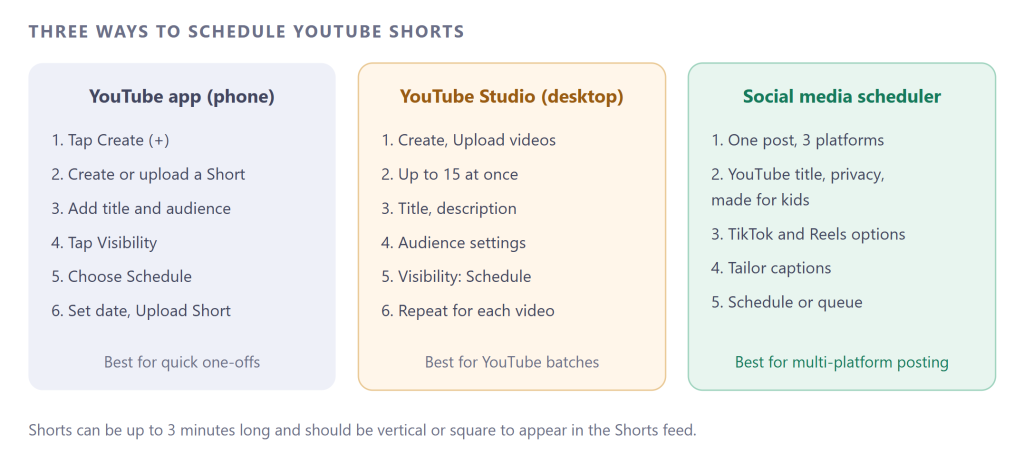
To schedule a YouTube Short on your phone, tap Create (the plus button), choose Create a Short or upload a vertical video, add a title and details, tap Visibility, choose Schedule, set the date and time, and tap Upload Short. On a computer, open YouTube Studio, click Create, Upload videos, add details, and on the Visibility step choose Schedule. YouTube Studio lets you upload up to 15 videos at once to schedule in bulk. A scheduler such as OnlySocial schedules Shorts alongside TikTok and Instagram Reels from one post.
Can You Schedule YouTube Shorts?
Yes, you can schedule YouTube Shorts on both mobile and desktop. YouTube treats Shorts as videos, so the same scheduling option that works for long-form uploads works for Shorts. You upload the video, add a title, description and settings, and choose a future date and time. Until then the Short stays private; at the scheduled time it becomes public automatically.
Scheduling is available to standard channels without special requirements. The exact layout varies slightly between the YouTube app, the YouTube Studio app and the desktop version of YouTube Studio, but each has a Visibility step with a Schedule option.
How to Schedule YouTube Shorts on Your Phone
You can schedule a Short right after creating it in the YouTube app. Here is how to schedule YouTube Shorts on a phone:
- Open the YouTube app and tap the plus (Create) button.
- Choose Create a Short to record in the app, or select a vertical video from your gallery to upload as a Short.
- Edit with music, text, filters or timing, then tap Next.
- Add details: a title, which is what viewers see, and settings such as audience (made for kids or not).
- Tap Visibility and choose Schedule.
- Set the date and time, then tap Upload Short or Schedule.
The Short uploads now and publishes later. If you do not see the Schedule option, update the YouTube app, or try the YouTube Studio app, which also supports scheduling uploads.
How to Schedule YouTube Shorts in YouTube Studio
YouTube Studio on a computer gives you the most control over scheduled Shorts.
- Go to studio.youtube.com and sign in to your channel.
- Click Create in the top right, then Upload videos.
- Select your vertical video. Shorts should be vertical or square and up to three minutes long.
- Add details: title, description, thumbnail options, playlists and audience. Mark whether the video is made for kids, which is required.
- Review video elements and checks. YouTube checks for copyright issues before publishing.
- On the Visibility step, choose Schedule, set the date, time and time zone, and click Schedule.
The Short appears in your Content tab as Scheduled. YouTube Studio is the best place to add descriptions, playlists and other details that are harder to manage on a phone.
How to Bulk Upload and Schedule YouTube Shorts
YouTube Studio lets you upload up to 15 videos at once, which makes batch scheduling much faster. Click Create, then Upload videos, and select several Shorts together. Each video gets its own upload card, where you add the title, details and audience settings, then choose Schedule and set a different time for each.
Plan your times before you start, for example one Short every day at 5pm for two weeks, so you can work through the cards quickly. For larger batches, or if you also post the same videos to TikTok and Instagram, a social media scheduler with bulk scheduling or a queue saves even more time: you add videos to a queue and they publish into your preset time slots automatically.
How to Schedule YouTube Shorts With a Scheduler
A YouTube Shorts scheduler is the fastest option if you repurpose videos across platforms. In OnlySocial, the steps are:
- Connect your YouTube channel and your TikTok, Instagram and Facebook accounts.
- Create a post and select the channel and accounts you want.
- Upload your vertical video from your device, Media Library, Dropbox or Google Drive.
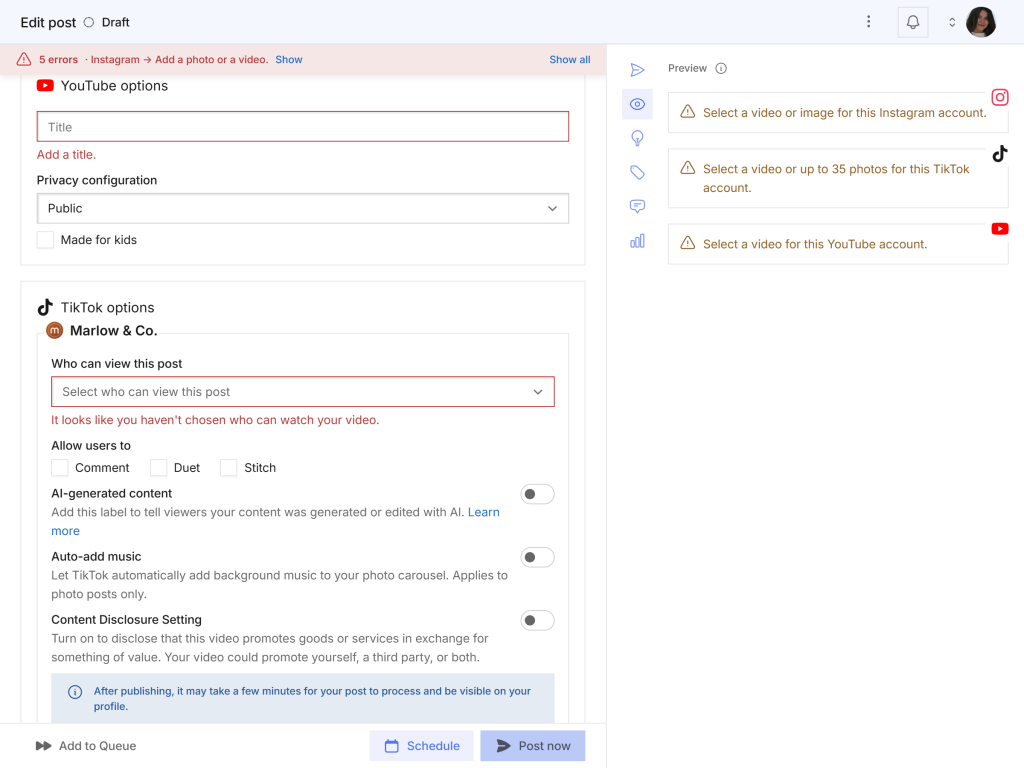
- Set YouTube options: a title, privacy (public, private or unlisted) and whether the video is made for kids.
- Set the other platforms’ options, such as Reel for Instagram and Facebook and privacy and Duet or Stitch settings for TikTok.
- Schedule or queue the post.
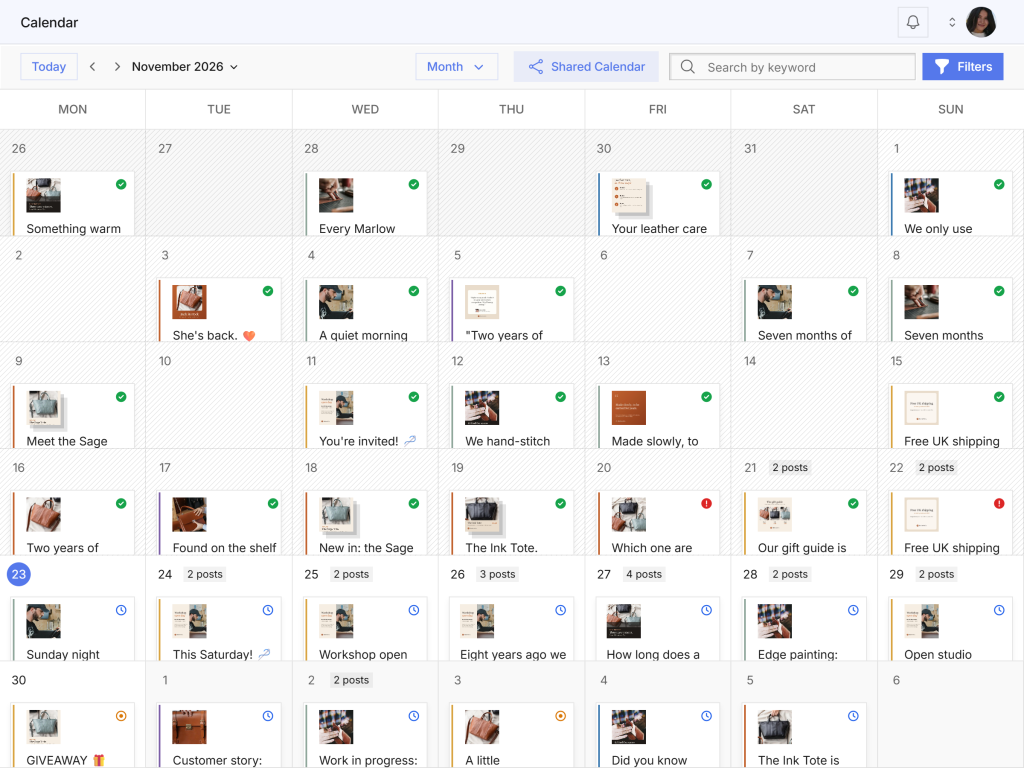
The composer checks each platform’s requirements before scheduling, so a missing YouTube title or TikTok privacy choice is flagged straight away, and everything appears on one calendar.
Which Method Should You Use?
Each method suits a different workflow.
| YouTube app | YouTube Studio | Scheduler (e.g. OnlySocial) | |
|---|---|---|---|
| Price | Free | Free | Paid (from $29 a month) |
| Device | Phone | Desktop and Studio app | Desktop and mobile |
| Bulk scheduling | No | Up to 15 uploads at once | Queue and bulk scheduling |
| Other platforms | No | No | TikTok, Instagram, Facebook and more |
| Calendar view | No | Content list | Calendar and queue |
| Best for | Quick one-offs | YouTube-only batches | Multi-platform creators and teams |
How to See, Edit or Cancel Scheduled Shorts
Scheduled Shorts appear in YouTube Studio’s Content tab. Open YouTube Studio, go to Content, and select the Shorts tab. Scheduled videos show their publish date and time under Visibility. Click the visibility label to change the time, publish immediately or switch to private. Click the video to edit its title, description and other details.
In the YouTube Studio app, open Content and filter by Shorts to see scheduled videos. If you scheduled through a third-party tool, your Shorts appear in that tool’s calendar until they publish. To cancel a scheduled Short, change its visibility to private or delete it before the scheduled time.
Make Sure Your Video Counts as a Short
Only vertical or square videos up to three minutes long appear as Shorts. YouTube expanded the maximum length of Shorts to three minutes in October 2024. Videos must have a square or vertical aspect ratio, ideally 9:16 at 1080 × 1920 pixels, to be classified as Shorts. A horizontal video, or one longer than three minutes, is treated as a regular video.
Keep text away from the bottom and right edges, where YouTube’s buttons and caption overlay sit. Add captions or on-screen text so the Short works without sound. If you include copyrighted music from outside YouTube’s library, longer Shorts in particular may be blocked, so use YouTube’s audio library or original sound.
Best Times to Schedule YouTube Shorts
The best time to schedule Shorts is a little before your audience is most active on YouTube. YouTube Studio Analytics has a “When your viewers are on YouTube” chart in the Audience tab, showing the days and hours your viewers watch most. Schedule Shorts an hour or two before those peaks so the video is ready when viewers arrive.
Because the Shorts feed recommends videos over days and weeks, a Short can find viewers long after it publishes, so timing matters less than consistency and quality. Still, a strong start helps: early views and engagement give YouTube signals that the Short is worth showing to more people. Test two or three times and compare views in the first 48 hours.
A YouTube Shorts Posting Schedule
Pick a frequency you can keep for months. Many growing channels post one Short a day, while others post three to five a week. Consistency matters more than volume. A simple plan is to film and edit five to seven Shorts in one session each week, then schedule them for the same time each day.
Give your Shorts recurring themes so viewers know what to expect, such as a quick tip on Mondays, behind the scenes on Wednesdays and a reaction or trend on Fridays. Link Shorts to your long-form videos with the related video feature, so Shorts viewers can discover your full videos. Review Shorts analytics monthly and make more of what holds viewers.
Scheduling vs Premieres
A scheduled Short simply goes public at a set time; a Premiere turns a video’s release into a live event. Premieres create a public watch page in advance, where viewers can set reminders, and then play the video as if live, with chat. Premieres are mainly used for long-form videos and are not the typical way to release Shorts. For Shorts, regular scheduling is usually the right choice.
If you want to build anticipation for a major long-form video, you can schedule a series of Shorts in the days before it premieres, each pointing viewers to the upcoming video. That combines the reach of Shorts with the event feel of a Premiere.
Titles and Descriptions for Scheduled Shorts
A scheduled Short needs a title that makes people stop and a description that helps YouTube understand it. The title appears over the video in the Shorts feed and in search results, so keep it short, clear and curious, such as “3 mistakes that ruin a leather bag” or “This took 14 hours to stitch”. Put the main topic words early, because viewers and YouTube’s search both read the start first.
Descriptions are less visible on Shorts but still useful: add a sentence about the video, a few relevant hashtags such as #shorts and topic tags, and a pointer to a related long-form video or playlist. Because you are writing in advance, take a moment to check spelling and make sure the title matches the first seconds of the video, which reduces swipe-aways.
Scheduling TikToks and Reels as YouTube Shorts
Most Shorts creators also post to TikTok and Instagram Reels, and scheduling all three together saves hours each week. Export your edit without a TikTok or Instagram watermark, because platforms prefer original uploads. Keep the core video the same, then adjust details for each platform: a YouTube title, TikTok privacy and Duet or Stitch settings, and an Instagram caption with a few hashtags.
Watch the length: Shorts can be up to three minutes, but if your TikTok is longer than that, trim it before scheduling it as a Short. Music is another difference: sounds added inside TikTok are not available on YouTube, so use YouTube’s audio library or original audio for Shorts. Over time, compare performance on each platform; some videos do far better on one than the others, which tells you where to focus.
Linking Shorts to Your Long-Form Videos
Shorts are a powerful way to send viewers to your longer videos. When uploading a Short, you can choose a related video, which adds a link on the Short that viewers can tap to watch the full video. Use it on Shorts that tease, summarise or cut from a long-form video, so curious viewers can go deeper.
A practical pattern is to schedule two or three Shorts cut from each new long-form video: one before it publishes as a teaser, one on release day, and one a few days later with a highlight. Each points to the full video. That gives the long-form video extra discovery from the Shorts feed and keeps your channel active between uploads.
Example: A Creator’s Weekly Shorts Workflow
Here is how a small channel might put scheduling into practice. A home cooking creator publishes one long recipe video a week. Every Sunday, they film five short clips: a 30-second version of the week’s recipe, a kitchen tip, a common mistake, a quick ingredient swap and a taste-test reaction. On Monday they edit all five vertically, add captions and export them without watermarks.
In their scheduler, they create five posts, each going to YouTube Shorts, TikTok and Instagram Reels, with a YouTube title, TikTok settings and an Instagram caption. They schedule one for 5pm each weekday, about an hour before their audience’s evening peak, and link the recipe Short to the full video. Comments from all three platforms arrive in one inbox, where they answer questions about ingredients. After a month, they see that mistake videos hold viewers longest and plan more of them.
Checking Shorts Analytics After Publishing
Scheduling saves time, but analytics show what to schedule next. In YouTube Studio, open a Short’s analytics to see views, the share of viewers who chose to view rather than swiping away, average view duration, likes, comments, shares and subscribers gained. Since March 2025, YouTube counts a Short view each time it starts to play or replay, so also look at engaged views and retention for a clearer picture of interest.
Once a month, compare your scheduled Shorts by topic, hook, length and publish time. Keep the formats that hold attention and bring subscribers, drop the ones that viewers skip, and test one new idea each week. A cross-platform analytics view helps you compare the same video on YouTube, TikTok and Instagram.
YouTube Shorts Scheduling Problems and Fixes
Most scheduling issues have simple fixes.
- No Schedule option on mobile. Update the YouTube app, or use the YouTube Studio app or desktop Studio.
- Video published as a regular video. Check that it is vertical or square and no longer than three minutes.
- Short blocked or restricted. Check for copyright claims on music or clips in YouTube Studio’s checks.
- Wrong publish time. Confirm the time zone in the scheduling settings.
- Scheduler failed to post. Reconnect your YouTube channel, and make sure the title and made-for-kids setting are filled in.
- Low views after scheduling. Scheduling does not reduce reach; look at your hook, retention and topic instead.
OnlySocial schedules YouTube Shorts with titles, privacy and made-for-kids settings alongside TikTok, Instagram Reels and Facebook Reels, with a calendar, queue and analytics, from $29 a month for 15 profiles.
Frequently Asked Questions
Can you schedule YouTube Shorts?
Yes, in the YouTube app, the YouTube Studio app, YouTube Studio on desktop, and with schedulers such as OnlySocial.
How do I schedule a YouTube Short on my phone?
Tap Create, make or upload a Short, add a title, tap Visibility, choose Schedule, set the date and time, and tap Upload Short.
Can I bulk upload and schedule YouTube Shorts?
Yes. YouTube Studio lets you upload up to 15 videos at once and schedule each one. Schedulers offer queues for larger batches.
How long can a YouTube Short be?
Up to three minutes, in a vertical or square format.
Where do I find scheduled Shorts?
In YouTube Studio, under Content, on the Shorts tab, where scheduled videos show their publish time.
Does scheduling Shorts affect views?
No. Views depend on how viewers respond, not on whether the Short was scheduled.
What is the best YouTube Shorts scheduler?
YouTube Studio is free for YouTube only. For posting the same Shorts to TikTok and Instagram, a scheduler such as OnlySocial saves time.
The Short Version
You can schedule YouTube Shorts from your phone, YouTube Studio or a scheduler. Use the app for quick Shorts, YouTube Studio for batches of up to 15, and a scheduler to post the same video to YouTube, TikTok and Reels together. Keep videos vertical and under three minutes, schedule before your viewers’ peak times, and post consistently.