On this page
- Why Timing Matters on Tumblr
- Best Time to Post on Tumblr
- When Is Tumblr Most Active?
- How to Find Your Own Best Time to Post on Tumblr
- When to Post on Tumblr by Blog Type
- Posting on Tumblr for a Global Audience
- Example: A Simple Tumblr Timing Test
- When to Post on Tumblr for Brands
- How Often to Post on Tumblr
- How to Use the Tumblr Queue
- How to Schedule a Post on Tumblr
- How to See Scheduled Posts on Tumblr
- Scheduling Tumblr Posts With Other Networks
- Which Tumblr Post Types to Schedule
- Tags and Timing on Tumblr
- Common Tumblr Posting Mistakes
- Frequently Asked Questions
- The Short Version
Tumblr works differently from most social networks. Posts spread through reblogs, tags and the Following feed, and a good post can keep collecting notes for months or even years. Timing still matters, though: a post that goes out when your followers are online gets its first reblogs faster, and those early reblogs carry it to new dashboards.
The challenge is that Tumblr does not publish an official “best time to post”, and generic advice copied from other platforms rarely fits Tumblr’s younger, global, night-owl audience. This guide explains when Tumblr tends to be most active, how to work out the best times for your own blog, and how to schedule Tumblr posts so they go out at those times without you being online.
Tumblr has no official best time to post. Its audience is young and skews towards the US and Europe, so evenings and late nights in US time zones, roughly 6pm to midnight Eastern, plus weekends, are usually strong starting points. Test those slots and compare notes in the first 24 hours. To schedule Tumblr posts, use the queue (up to 300 posts, published 1 to 50 times a day in a time window you choose), the Schedule option in the post editor, or a social media scheduler such as OnlySocial.
Why Timing Matters on Tumblr
On Tumblr, the first hours after posting decide how far a post travels. Your followers see new posts in their Following feed, which shows posts in order. If they are online when your post goes out, they are more likely to see it, like it and reblog it. Each reblog puts your post on another dashboard, where it can be reblogged again, so a strong start compounds.
Tumblr also has a For You feed and tag pages that surface posts beyond your followers, based on interests and engagement. Early notes help a post appear there too. Because good Tumblr posts keep circulating for a long time, timing matters most for the initial push rather than the whole life of the post.
Best Time to Post on Tumblr
The best time to post on Tumblr is when your own followers are online, which for most blogs means evenings and weekends. Tumblr’s audience is young, with many users in their teens and twenties, and it is concentrated in the United States, with large communities in Europe and elsewhere. Younger users tend to browse after school, college or work, and late into the night.
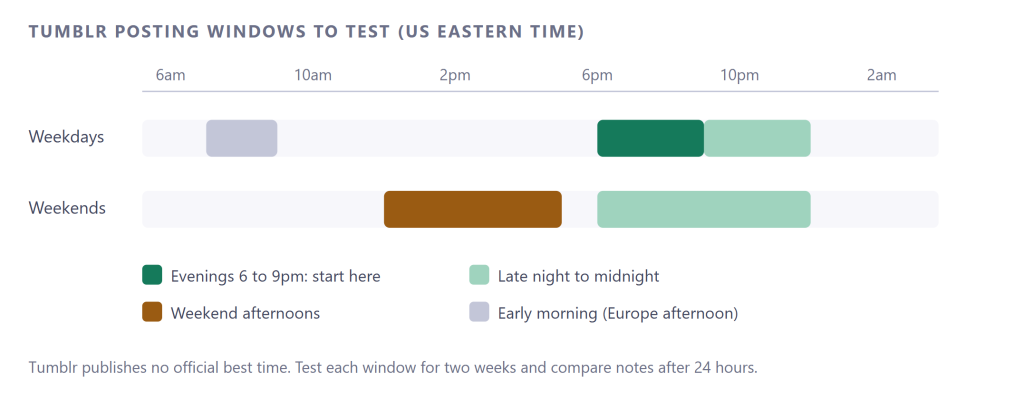
As a starting point, test these windows, all in US Eastern time:
| Window | Why it can work |
|---|---|
| Weekday evenings, 6pm to 9pm | Students and workers are free; US East Coast is online and the West Coast is finishing work |
| Late night, 9pm to midnight | Tumblr’s audience is known for late-night browsing; West Coast evening |
| Weekend afternoons | More free time for longer browsing and reblogging sessions |
| Early morning, 7am to 9am | Catches European afternoons and US early risers |
These are hypotheses, not rules. A fandom blog with followers in Asia, a UK art blog, or a professional brand account may see completely different patterns. Treat them as slots to test, then let your own notes decide.
When Is Tumblr Most Active?
Tumblr tends to be most active in the evening and at night in US time zones, and around major fandom moments. Unlike platforms used heavily during the working day, Tumblr is a leisure platform for many people, so activity rises after school and work hours. Weekends see long browsing sessions, and activity spikes around TV episode releases, film premieres, game launches, award shows and other events that communities discuss live.
For fandom and pop culture blogs, the best time to post is often right after an episode airs or a trailer drops, when people are searching tags and reblogging reactions. For evergreen content, such as art, photography, writing and tutorials, a steady schedule at your followers’ usual active times works better.
How to Find Your Own Best Time to Post on Tumblr
Your blog’s best time depends on your followers, so test and measure. Tumblr’s built-in analytics are limited compared with other networks, but you can still learn a lot.
- Pick three or four time slots from the windows above, such as 7am, 7pm and 11pm Eastern.
- Post similar content in each slot for two weeks, so the comparison is fair.
- Record notes after 24 hours for each post, splitting likes and reblogs if you can, since reblogs drive reach.
- Check your Activity page, which shows notes and new followers over time, to see when people interact most.
- Look at your followers: many blogs show time zones in their descriptions, and fandom communities often cluster in particular regions.
- Keep the winners and test a new slot each month, because audiences shift over time.
Keep a simple spreadsheet with post type, tags, time and notes. After a month or two, patterns become clear, and your schedule can be built on your own data rather than general advice.
When to Post on Tumblr by Blog Type
The best time depends on what you post and who reads it. Here is how timing tends to differ by type of blog, as a starting point for your own tests.
- Fandom blogs. Post reactions, edits and GIF sets as soon as possible after an episode, trailer or announcement, while tags are busy. Between events, evenings in your fandom’s main time zone work well.
- Art and illustration. Weekend afternoons and weekday evenings, when people browse at leisure and reblog visual work. Consider posting at the start of a weekend session so art circulates through Saturday and Sunday.
- Writing and text posts. Late evenings and nights, when readers have time for longer posts. Serialised fiction benefits from a fixed day and time readers can expect.
- Photography and aesthetics. Evenings and weekends, with consistent posting through the queue to keep a steady visual stream.
- Brands and businesses. Weekday evenings for engagement, and times your customers are likely to click through for link posts. Align launches with your other channels.
- Educational and niche hobby blogs. Steady posting at your followers’ active times, with evergreen posts queued to fill gaps.
Posting on Tumblr for a Global Audience
Tumblr users are spread across many time zones, so a single best time rarely fits everyone. If your followers are mostly in the US, Eastern evening times also reach the Central and Pacific time zones while they are awake. If you have a strong European following, early morning US posts reach Europe in the afternoon. For followers in Asia or Australia, late-night US posts can land in their morning or midday.
The queue makes this easier: set a wide time window, such as 7am to 1am, and a few posts a day, and your content will reach different regions throughout the day. For important posts, schedule them for the time zone where most of your engaged followers live, and repost or reblog later for other regions if it suits your blog. Always check whether your scheduler uses your account’s time zone or your device’s, especially when you travel.
Example: A Simple Tumblr Timing Test
Here is how an illustrator might find their best posting time in a month. They pick three slots: 8am, 7pm and 11pm Eastern. For two weeks, they schedule one new illustration in each slot on rotating days, using the same set of tags each time. After 24 hours, they note the number of notes and reblogs for each post in a spreadsheet.
By the end of the second week, the 7pm posts average roughly twice the reblogs of the 8am posts, and the 11pm posts sit in between. They also notice that Sunday posts outperform weekday ones. For the next month, they move their main posts to 7pm and Sunday afternoons, keep one late-night slot for sketches, and use the queue to share older work and reblogs throughout the day. Small, regular tests like this beat any general rule.
When to Post on Tumblr for Brands
Brands on Tumblr do best when they behave like members of the community, and timing is part of that. Post when your audience is relaxed and browsing, usually evenings and weekends, rather than during office hours. Join conversations around events your audience cares about while they are happening, with posts that add something rather than pure promotion. Use the queue to keep a steady presence with reblogs of fans’ work and behind-the-scenes content between campaigns.
Coordinate Tumblr with your other channels: if you launch a product on Instagram and X at 6pm, schedule a Tumblr post with extra visuals or a longer story for the same moment, and queue follow-up posts for the following days. A shared calendar across networks keeps launches consistent and prevents gaps.
How Often to Post on Tumblr
Tumblr rewards regular posting, and reblogs count as posts, so frequency is easier to keep up than on many networks. Many active blogs post several times a day, mixing original posts with reblogs of content their followers will enjoy. For a brand or creator, one to three original posts a day, plus thoughtful reblogs, is a strong rhythm. Even a few original posts a week, published consistently, can grow a blog over time.
Spreading posts across the day is better than posting a burst all at once, which can flood followers’ feeds and lead to fewer reblogs per post. That is exactly what the Tumblr queue is designed for.
How to Use the Tumblr Queue
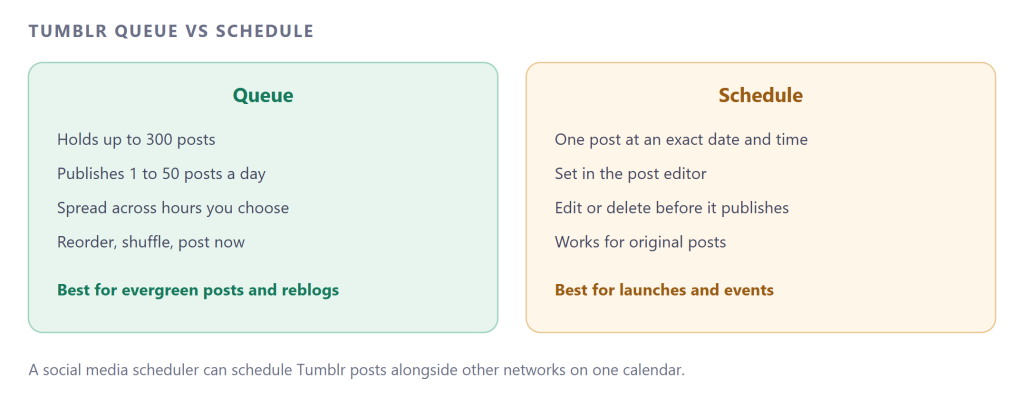
The queue is Tumblr’s built-in tool for spreading posts out automatically. Instead of publishing straight away, you add posts and reblogs to your queue, and Tumblr publishes them at regular intervals. Your queue can hold up to 300 posts, and you choose how many to publish each day, from 1 to 50, and the hours between which they go out.
- Write a post or reblog as usual.
- Open the posting options by clicking the arrow next to Post now.
- Choose Queue, then confirm. The post joins your queue.
- Set your queue schedule on your blog’s Queue page: choose how many posts per day and the time window, for example 4 posts between 9am and 11pm.
- Reorder or shuffle queued posts, edit them, or publish one immediately from the Queue page.
The queue is ideal for steady, evergreen content and for reblogs you want to share over time. It is less suited to posts that must go out at an exact time, which is where scheduling comes in.
How to Schedule a Post on Tumblr
Tumblr’s scheduler publishes a single post at an exact date and time. Yes, you can schedule posts on Tumblr on the web and in the app:
- Create your post: text, photo, quote, link, chat, audio or video.
- Add tags so people can find it.
- Click the arrow next to Post now (on mobile, tap the settings or clock icon before posting).
- Choose Schedule and pick the date and time.
- Confirm with Schedule. The post will publish automatically at that time.
Scheduling suits time-sensitive posts, such as an announcement timed to a launch, a reaction post timed to an episode, or a post for a specific date. Remember that times are based on your device or account time zone.
How to See Scheduled Posts on Tumblr
Scheduled posts appear alongside your queued posts on your blog’s Queue page, marked with their publishing time. Open your blog, go to Queue, and you will see scheduled posts listed with the date and time they will publish. From there you can edit the post, change the time, publish it now or delete it. Drafts, which are not scheduled at all, live in your Drafts section.
If you schedule Tumblr posts through a social media scheduler, they appear in that tool’s calendar or queue instead, because the scheduler publishes them through Tumblr’s API at the chosen time.
Scheduling Tumblr Posts With Other Networks
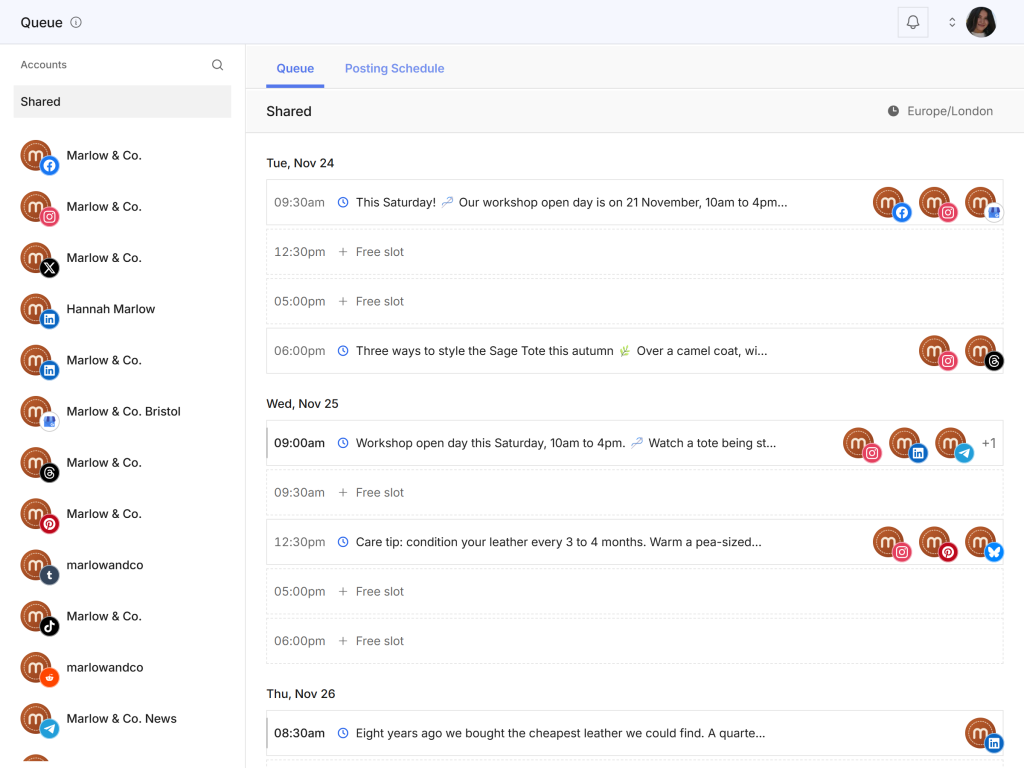
If Tumblr is one of several networks you manage, a social media scheduler saves time. Tumblr’s own tools only handle Tumblr. A scheduler lets you write one post, adapt it for Tumblr, Instagram, X, Bluesky, Pinterest and others, and schedule everything on one calendar. In OnlySocial, Tumblr is one of the supported networks: you choose the Tumblr post type, add tags and media, and schedule it or add it to a queue with time slots you set.
That is useful for creators and brands who repurpose art, photos, articles and videos across platforms, and for teams who need approvals before posts go out. You can also see Tumblr posts next to everything else you have scheduled, so your calendar stays balanced.
Which Tumblr Post Types to Schedule
Almost every Tumblr post type can be queued or scheduled. Original art and photography do well on evenings and weekends when people browse visually. Text posts, essays and writing suit late-night readers. Link posts promoting a blog article or shop work best at times your audience is most likely to click through. GIF sets and fandom content should go out close to the moment they relate to. Reblogs of other creators’ work can fill your queue between original posts, keeping your blog active without constant new content.
Mix types through the week, and use your notes to see which ones perform best at which times. For example, you might find that art does best on Sunday afternoons, while text posts get more reblogs late on weeknights.
Tags and Timing on Tumblr
Tags decide where your post appears; timing decides how many people see it when it gets there. Tumblr’s tag pages and search surface recent and popular posts, so posting into a busy tag at a busy time gives your post a chance to be seen by people who do not follow you. Use specific tags that describe the content, the fandom, the medium and the topic, plus a few broader community tags.
For event-driven tags, such as a new episode or a convention, timing is critical: post while the tag is busy. For evergreen tags, such as a style of art or a hobby, steady posting at your usual best times works well. Avoid unrelated popular tags, which annoy communities and can get your posts filtered out.
Common Tumblr Posting Mistakes
A few habits hold many blogs back. Posting everything in one burst floods followers’ feeds; use the queue instead. Copying “best times” from Instagram or LinkedIn ignores Tumblr’s evening, night-owl audience. Forgetting time zones means posts go out while your followers sleep. Using no tags, or irrelevant ones, limits discovery. Never testing means you keep guessing. And neglecting reblogs and community interaction makes a blog feel like a broadcast rather than part of Tumblr’s culture.
OnlySocial schedules Tumblr posts alongside Instagram, X, Bluesky, Pinterest and more, with a queue, calendar, approvals and analytics, from $29 a month for 15 profiles.
Frequently Asked Questions
What is the best time to post on Tumblr?
There is no official answer, but evenings and late nights in US time zones, roughly 6pm to midnight Eastern, and weekend afternoons are good starting points. Test and use your own notes.
When is Tumblr most active?
Usually in the evening and at night in US time, at weekends, and around fandom events such as episode releases.
Can you schedule posts on Tumblr?
Yes. Use Schedule in the post editor for an exact time, or add posts to the queue, which publishes them automatically through the day.
How many posts can a Tumblr queue hold?
Up to 300 posts, published 1 to 50 times a day in a time window you choose.
How do I see scheduled posts on Tumblr?
Open your blog’s Queue page, where scheduled posts are listed with their publishing time.
How often should I post on Tumblr?
One to three original posts a day plus reblogs is a strong rhythm, but consistent posting a few times a week can also grow a blog.
Can I schedule Tumblr posts with other social networks?
Yes, with a social media scheduler such as OnlySocial, which supports Tumblr alongside other networks.
The Short Version
The best time to post on Tumblr is when your followers are online, which usually means evenings, late nights and weekends in US time. Test a few slots and compare notes, use the queue to spread posts through the day, schedule time-sensitive posts for exact times, and use a scheduler if you manage Tumblr alongside other networks.