On this page
- What Is VKontakte?
- A Short History: From Durov to the State
- What You Can Do on VK
- A Quick VK Glossary
- VK vs Facebook: How Similar Are They?
- Is VK Safe?
- Who Uses VK, and Where?
- VK, Odnoklassniki and Telegram: Russia’s Social Media Map
- Why People Call VK the “Russian Facebook”
- Should Your Brand Be on VK?
- Posting to VK With OnlySocial
- How to Create a VK Account
- Frequently Asked Questions
- The Short Version
Maybe a friend sent you a vk.com link. Maybe a customer in Kazakhstan asked if you are “on VK”. Maybe you saw a headline about Russia’s internet and wondered why everyone there seems to use a different social network. Whatever brought you here, the question is the same: what is VKontakte, and should you trust it?
The short version is that VKontakte, usually just called VK, is Russia’s biggest social network, often described as “Russia’s Facebook”. It looks and works a lot like Facebook did a decade ago, with extras such as music, video, mini apps and a messenger built in. It is also owned by companies close to the Russian state and governed by Russian data laws, which matters a great deal when you ask whether it is safe. This guide covers both sides plainly, so you can decide for yourself.
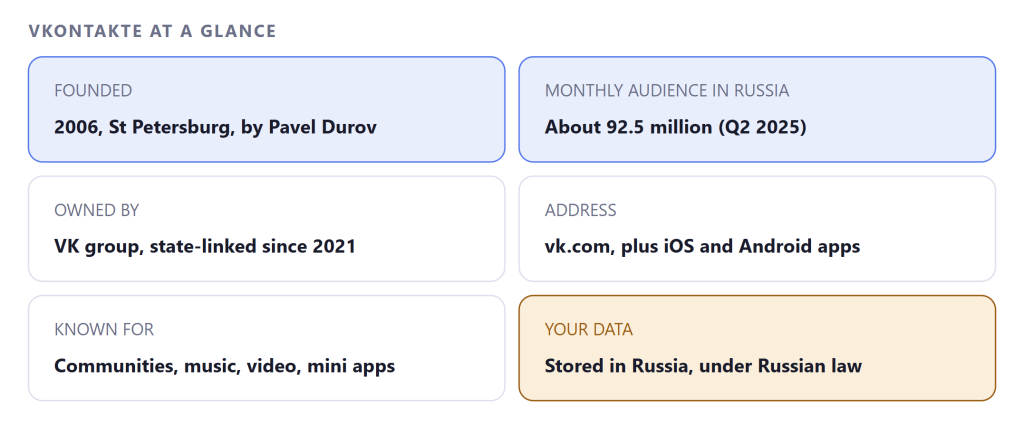
VKontakte (VK) is a Russian social network founded in 2006 by Pavel Durov, who later created Telegram. It is the most used social network in Russia, with an average monthly audience of about 92.5 million users there in mid-2025. Since 2021 it has been controlled by companies linked to the Russian state, and Russian law requires it to store user data in Russia and give security services access. Technically it is a normal platform with two-factor login, but it is not private from the Russian state.
What Is VKontakte?
VKontakte is a social networking site and app, based in Russia, where people keep a profile, add friends, join communities, message each other and share photos, video and music. The name means “in contact” in Russian. Most people simply call it VK, and its main address is vk.com.
If you used Facebook around 2012, VK will feel familiar. There is a news feed, a profile wall, friend requests, likes and comments, groups and public pages (VK calls them communities), events and private messages. VK then adds things Facebook never focused on: a large music library, a video platform that competes with YouTube in Russia, short videos called Clips, games and thousands of mini apps that run inside VK.
VKontakte is run by VK, a Russian technology group that also owns the Odnoklassniki social network, the Mail.ru email service, VK Video, the MAX messenger and other services. When people say “VK” they can mean either the social network or the whole company, which causes some confusion. In this article, VK means the social network unless we say otherwise.
A Short History: From Durov to the State
VK’s story explains most of what people worry about today, so it is worth two minutes.
2006: a student network in St Petersburg
Pavel Durov launched VKontakte in 2006, aimed at university students and graduates, much as Facebook began at universities in the US. It grew quickly by being fast, free and generous: users could upload music and video freely, which made it hugely popular and also brought years of copyright disputes with record labels. Within a few years it was the most visited site in Russia.
2014: Durov leaves
In 2014 Durov lost control of the company. He has said he refused Russian security services’ requests to hand over data on organisers of the protests in Ukraine and to block an opposition politician’s community. He sold his remaining stake and left Russia. By then he had already started working on a new app: Telegram. The Mail.Ru Group, owned by billionaire Alisher Usmanov, took full control of VK.
2017: banned in Ukraine
Ukraine blocked VK and other Russian internet services in 2017, citing national security. VK had been one of the most used sites in Ukraine too, and the ban pushed many Ukrainian users to Facebook, Instagram and Telegram.
2021 onwards: state-linked control
Mail.Ru Group renamed itself VK in 2021. Later that year, companies linked to the Russian state, the insurer Sogaz and Gazprom Media, gained effective control of the group’s decisions, and Vladimir Kiriyenko, son of a senior Kremlin official, became its chief executive. Since then VK has been treated in Russia as a national platform: it built the national messenger MAX, and Russian state funding has supported VK Video as a home-grown rival to YouTube. After Western sanctions in 2022, Apple removed VK’s apps from its App Store for a period, and Western advertising and payments to Russia largely stopped.
What You Can Do on VK
VK is less a single app than a bundle of services under one login, called VK ID. Here are the main parts.
- Profiles and friends. A personal page with a wall, photos, interests, education and work, and a friends list. Profiles can be open or closed to strangers.
- Communities. VK’s version of Facebook groups and Pages. Public pages suit brands, media and creators; groups suit discussion; event communities handle meet-ups. Communities can sell products, take messages and run mini apps.
- Messages. Private and group chats with voice and video calls, also available as a separate VK Messenger app.
- Music. A large licensed music library with paid subscriptions, one of the reasons younger users stay.
- VK Video and Clips. Long-form video, live streams and short vertical videos, competing with YouTube and TikTok inside Russia.
- Mini apps and games. Services that run inside VK, from food delivery to taxi booking and games.
- Ads. VK Ads lets businesses target users by interest, location and demographics, similar to Meta’s ad tools.
The interface is available in many languages, including English, but most content, communities and customer support are in Russian.
A Quick VK Glossary
A few VK terms come up again and again, and knowing them makes the app much easier to follow, especially if you are using it in English for the first time.
- Wall. The feed of posts on a profile or community page, like a Facebook timeline. Friends can post on your wall unless you turn that off in privacy settings.
- Community. The umbrella word for groups, public pages and events. Russian users often call a public page a “pablik”, from the English word public.
- Repost. VK’s share button. Reposting puts someone else’s post on your wall or in a community, with the original attached, much like sharing on Facebook.
- Clips. Short vertical videos, VK’s answer to Reels and TikTok.
- Stories. Photos and videos that disappear after a day, as on Instagram.
- VK ID. The single login for VK, Odnoklassniki, Mail.ru and other services in the group. Many Russian websites also offer “log in with VK ID”.
- Mini apps. Small services that run inside VK, from games and quizzes to shops and booking tools.
- Donut. A way for creators and communities to sell paid subscriptions to their followers inside VK, similar to Patreon.
If you are messaging relatives or friends, you only really need the first four. Brands and creators should learn all of them, because communities, Clips and paid subscriptions are where VK differs most from Western platforms.
VK vs Facebook: How Similar Are They?
“Russia’s Facebook” is a fair nickname for the basic layout, but the two have grown apart in what they emphasise and who they answer to.
| VKontakte | ||
|---|---|---|
| Home market | Russia and Russian speakers | Worldwide |
| Owner | VK group, state-linked since 2021 | Meta, a listed US company |
| Groups and Pages | Communities (public pages, groups, events) | Groups and Pages |
| Music | Large built-in music library | Limited (music in Reels and Stories) |
| Video | VK Video and Clips | Facebook Video and Reels |
| Messaging | Built in, plus VK Messenger and MAX | Messenger, WhatsApp |
| Data rules | Russian law; data stored in Russia | US and local laws such as GDPR in the EU |
| Status in Russia | Fully available | Blocked since 2022 |
That last row is important. Russia blocked Facebook and Instagram in 2022 and labelled Meta “extremist”, so for people in Russia, VK and Telegram became the default ways to stay in touch publicly. If you want to reach people inside Russia on a social network, VK is one of very few options left.
Is VK Safe?
It depends on what you mean by safe. VK is a mainstream platform with normal account security, but it offers little privacy from the Russian state, and that is the risk that matters most. “Is VK safe” is one of the most common questions people ask about VKontakte, so here is each part of the answer.
Is the website itself safe to visit?
Yes, in the everyday sense. vk.com is a large, established site that uses encrypted connections, like any major social network. Visiting it will not infect your device. The usual internet risks apply: scam messages, fake giveaways, phishing links and dodgy files shared in communities. Treat links and downloads on VK as carefully as you would anywhere else.
Is your account secure?
VK offers two-factor authentication, login alerts and session management. Use a unique password and switch on two-factor login. That matters on VK in particular because it has a history of password leaks: in 2016, around 100 million VK account details from an older breach were put up for sale online, and the leaked lists showed how many people used passwords like “123456”. If you ever used the same password on VK and elsewhere, change it everywhere.
Is your data private?
This is where VK is very different from Western platforms. Russian law requires services like VK to store Russian users’ personal data on servers in Russia, and other laws require internet companies to keep users’ messages and data for a period and hand them to security services on request. VK’s ownership by state-linked companies adds to that concern. In practice, you should assume that anything you post or send on VK, including private messages, could be read by Russian authorities.
For most people abroad chatting with relatives, that may be an acceptable trade-off. For journalists, activists, people with family in sensitive situations, or anyone discussing politics, it is a serious risk. In those cases, an end-to-end encrypted messenger is the safer choice.
Is it legal to use?
In most countries, yes, for personal use. Ukraine is the notable exception, where VK is blocked. Businesses should be more careful: sanctions rules in the EU, UK and US can limit paying Russian companies, including for advertising. If you plan to spend money on VK, check the current sanctions rules for your country first.
VK is secure enough for everyday use with a strong password and two-factor login, but not private. Do not share anything on VK, even in private messages, that you would not want the Russian state to read.
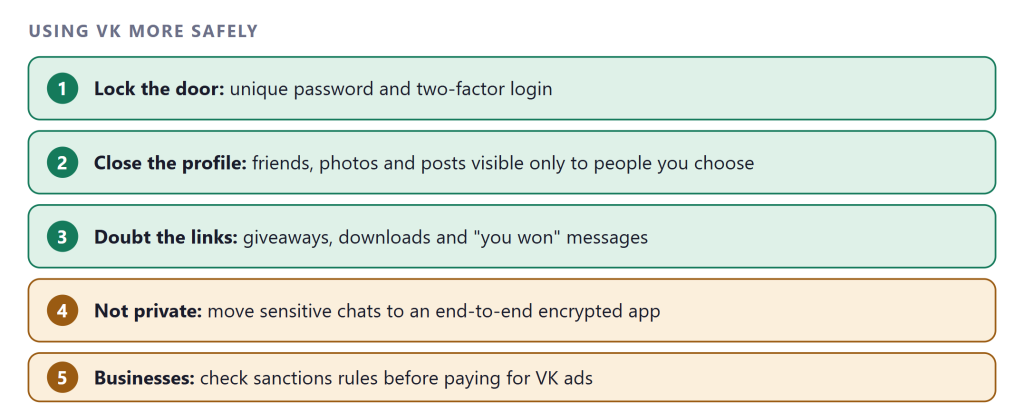
How to tighten your VK privacy settings
Open Settings, then Privacy. Go through each line: who can see your profile, your friends list, your photos, your posts and your phone number; who can message you; who can find you by phone number. Set anything you do not need public to “Only friends” or “Only me”. You can also make your whole profile closed, so people who are not your friends see only your name and photo. Finally, check Security for active sessions and log out of any device you do not recognise.
Who Uses VK, and Where?
VK’s audience is concentrated in Russia, with smaller communities among Russian speakers in nearby countries and abroad. VK reported an average monthly audience of about 92.5 million VKontakte users in Russia in the second quarter of 2025, which makes it the country’s most used social network by a wide margin.
Outside Russia, VK is used by Russian speakers in Belarus, Kazakhstan and other former Soviet countries, and by diaspora communities who keep in touch with family. Its reach in Western Europe and North America is small and has shrunk since 2022.
The audience skews younger than Facebook’s in the West: VK has long been the default network for Russian students and young adults, helped by its music and video. Older Russians tend to use Odnoklassniki, VK’s sister network, while Telegram channels compete for news and creator audiences.
VK, Odnoklassniki and Telegram: Russia’s Social Media Map
VK is the biggest piece, but it is not the whole picture. If you are trying to understand where Russian speakers spend time online, it helps to see how the main platforms divide the audience.
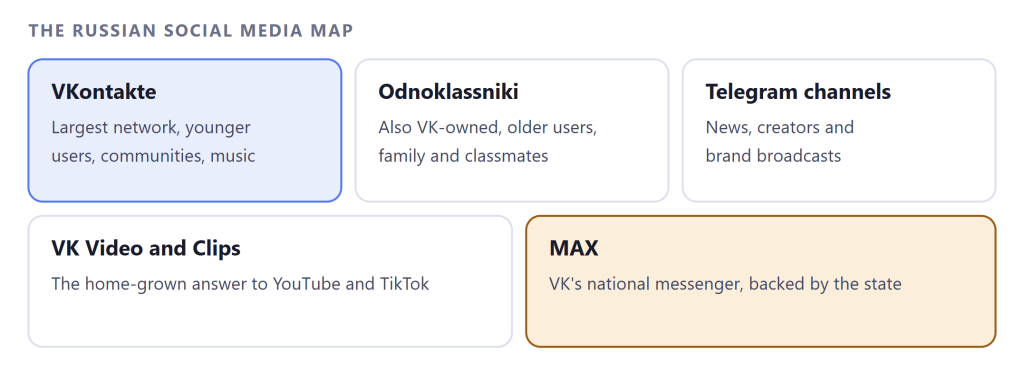
Odnoklassniki (OK)
Odnoklassniki, meaning “classmates”, is Russia’s second big social network and is also owned by VK. It is popular with older users who use it to find old school friends, share family photos and play games. If your customers are over 45, OK can matter as much as VK.
Telegram
Telegram is not a social network in the same sense, but its public channels have become a main source of news, commentary and creator content for Russian speakers. Many brands and media run a Telegram channel alongside a VK community, using Telegram for quick updates and VK for community and commerce.
VK Video, Clips and MAX
Since 2022, VK has invested heavily in video, with state support, to give Russian viewers an alternative to YouTube. VK Video reported a monthly audience of more than 80 million in early 2026. In 2025 VK also launched MAX, a messenger the Russian government promotes as a national alternative to WhatsApp and Telegram, with more than 100 million registered users by early 2026 according to VK. The same privacy considerations apply to MAX as to VK itself.
Why People Call VK the “Russian Facebook”
The “Russian Facebook” label stuck early, and it still describes the experience well, even though VK has developed its own identity. When VK launched, its blue colour scheme, profile layout and university focus looked very close to Facebook’s. Over time, the differences grew: VK leaned into music, video and communities, while Facebook leaned into Pages, Marketplace and ads at global scale.
Today the nickname works best as shorthand for the role VK plays rather than how it looks. In Russia, VK is where people keep a public profile, follow brands and public figures, join local groups and share life updates, exactly the role Facebook plays in much of the world. For anyone outside Russia trying to understand it quickly, “Russian Facebook, with a music library and a YouTube competitor built in” is a fair summary.
Should Your Brand Be on VK?
Only if your customers are Russian speakers in Russia or nearby countries, and only after you have checked the legal side. For most brands outside that region, VKontakte is not worth the effort.
When VK makes sense
- You sell to customers in Russia, Belarus or Central Asia and are legally allowed to.
- Your audience is Russian-speaking, and VK is where they talk about your category.
- You already create content in Russian and can answer messages in Russian.
When it does not
- Your customers are in Western Europe, North America or most of Asia. They are on Instagram, Facebook, TikTok, LinkedIn and YouTube.
- You cannot pay for ads because of sanctions or banking restrictions.
- You have no one to reply in Russian. A community nobody answers does more harm than no community.
How brands use VK well
Brands that do well on VK run a public community page as their hub, post regularly with a mix of photos, Clips and longer video, reply to comments and messages quickly, and use VK’s community shop features to show products. VK Ads can target people very precisely by interest and region. As on any network, consistency beats bursts: a community that posts three times a week every week builds trust; one that posts ten times in a launch week and then goes silent does not.
If you also target Russian speakers through other channels, Telegram channels are often the second pillar alongside VK. Our guide to Telegram marketing explains how they work.
Posting to VK With OnlySocial
OnlySocial can schedule posts to a VKontakte profile alongside your other networks, so a VK post can go out at the same time as your Instagram, Facebook or Telegram posts. Go to Accounts, click Connect account, choose VKontakte and log in with VK. You can then select the VK account in the composer like any other, add text, photos or a video, and schedule it on the same calendar as everything else.
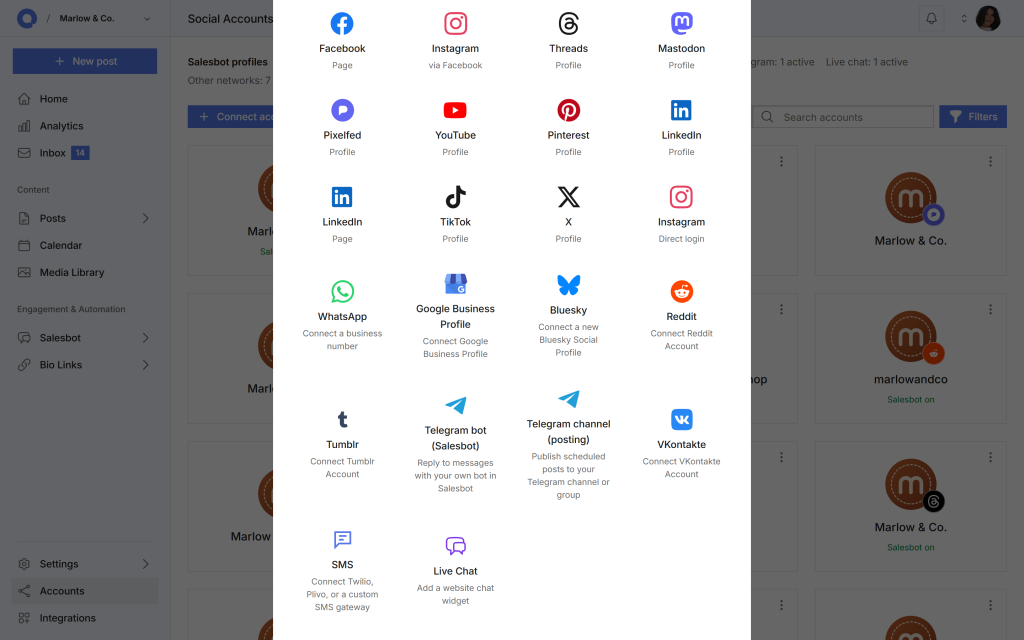
To be straightforward about the limits: OnlySocial currently posts to the VK profile you connect, not to VK communities. If your brand’s VK presence is a community page, you will need to post there in VK itself for now. OnlySocial is a good fit if VK is one of several networks you manage and you want one calendar for all of them; if VK communities are your main channel, VK’s own tools may suit you better.
What it costs: every OnlySocial plan includes VKontakte along with Facebook, Instagram, TikTok, LinkedIn, X, YouTube, Telegram and more, 15+ networks in total. The $29 Freelancer plan includes 15 social profiles, the $49 Entrepreneur plan 40, and the $99 Unlimited Pro plan unlimited profiles.
Managing several networks? Plan VK, Telegram, Instagram, Facebook and the rest from one calendar, with one inbox for replies.
How to Create a VK Account
Signing up takes a few minutes and needs a phone number.
- Go to vk.com or download the VK app from your app store.
- Choose to sign up and enter your phone number. VK sends a code by text message or call to confirm it.
- Enter your name, date of birth and a password, then add a profile photo if you like.
- Before you add friends or post anything, open Settings, then Privacy and Security, and set them as described above. Switch on two-factor login.
VK accounts are tied to phone numbers, and some services may treat numbers from certain countries differently. If you are signing up from outside Russia, the interface can be switched to English in settings.
How to delete a VK account
Open Settings and look for the option to delete your page, usually at the bottom of the general settings. VK may give you a period in which you can restore the page before it is removed. Deleting your page does not guarantee that data already stored or shared with authorities is erased, so think about what you post before you post it.
Frequently Asked Questions
What is VKontakte?
VKontakte, or VK, is Russia’s largest social network, founded in 2006. It offers profiles, friends, communities, messages, music, video and mini apps, and is often called “Russia’s Facebook”.
What is vk.com?
vk.com is the web address of VKontakte. The same service is available through the VK apps for iPhone and Android.
Is VK safe to use?
VK is secure enough for everyday use if you use a strong password and two-factor login. It is not private from the Russian state: Russian law gives security services access to user data, so avoid sharing anything sensitive there.
Is VK.com safe to visit?
Yes. It is a mainstream site with encrypted connections. As anywhere online, be careful with links, giveaways and downloads shared by other users.
Who owns VKontakte?
VKontakte is run by the Russian technology group VK. Since 2021, companies linked to the Russian state, including Gazprom Media and the insurer Sogaz, have had effective control of the group.
Why is VK called Russia’s Facebook?
Because its layout and core features, a news feed, profiles, friends, groups and messages, closely resemble Facebook, and because it plays the same role in Russia that Facebook plays in many other countries.
Is VK owned by the creator of Telegram?
No longer. Pavel Durov founded VK in 2006 but left in 2014 and later built Telegram. He has had no role in VK since.
Can I use VK outside Russia?
Yes, VK works in most countries and has an English interface. It is blocked in Ukraine. Most content and communities are in Russian.
Is VK still on the App Store?
Availability has changed over time because of sanctions; Apple removed VK’s apps in 2022. Check your country’s App Store and Google Play for the current situation.
Can I schedule posts to VK?
Yes. VK lets you schedule posts natively, and OnlySocial can schedule posts to a connected VK profile alongside your other social networks.
The Short Version
VKontakte is Russia’s biggest social network: a feature-rich, Facebook-like platform with about 92.5 million monthly users in Russia, controlled since 2021 by state-linked companies and run under Russian data law. It is secure enough for everyday chats with a strong password and two-factor login, but it is not private from the Russian state. For brands, VK only makes sense if your customers are Russian speakers you are legally able to serve.
If VK is one network among several for you, OnlySocial can schedule it with the rest from one calendar.